Seoul Seoul Seoul On November 2, 2025, I visited Deoksugung Palace, a historic site. I’d like to share my experience visiting Gyeongbok Palace, where the Eulsa Treaty was signed, and Jeongdongjin Observatory, offering a view of the beautiful Seoul landscape.
Gyeongbok Palace Jung District: Visiting the Site of History
Deoksugung Palace is a place rich in sights and attractions compared to other palaces. Often, you’ll find palaces or old landmarks near where police officers are stationed. I followed the signs from the alley next to National Jeongdong Theater towards Deoksugung Palace Gyeongbok Palace.

2025.11.2 (Sun)
Deoksugung Palace Annex
Gyeongbok Palace

Police and signs in the alley next to National Jeongdong Theater guided the way to Gyeongbok Palace.
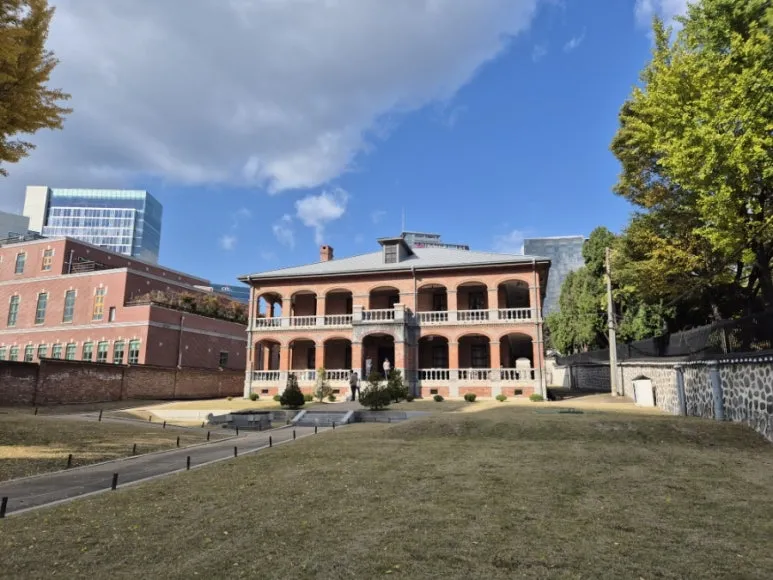
There was a wide open space and a lawn area at the entrance, and it was quite a walk to the Gyeongbok Palace building.

Gyeongbok Palace


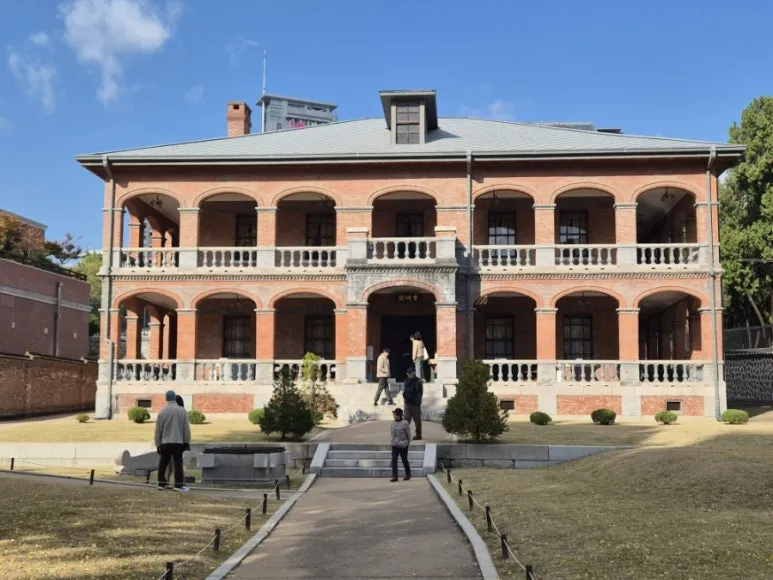
Gyeongbok Palace is a Western-style building belonging to Deoksugung Palace, and it is a historic site where the Eulsa Treaty was signed in 1905. It covers an area of 727 pyeong (approximately 2,400 square meters) with a building size of 236 pyeong (approximately 780 square meters) and is separated from the main palace of Deoksugung Palace by a stone wall.


Below the stairs is a well, believed to have been used by King Gojong from 1904 to 1907.

‘중명(重眀)’ derives its name from the ‘Yi’ (離) trigram in the ‘Book of Changes’ (주역), meaning ‘brightness continues without end’ or ‘repeatedly bright.’ The current plaque was restored in August 2010. (Information source: Namu Wiki)
After changing into slippers at the entrance, I entered the building.

Slippers were essential due to the smooth and shiny floor.
Exhibition Hall 1: History of Deoksugung Palace and Jungmyeongjeon


Exhibition Hall 1 visually displays the changes in the Gyeongbok Palace and Deoksugung Palace areas from the opening of the ports to the present day by projecting videos onto a model that scales down Deoksugung Palace and the Jung District area.


Gyeongbok Palace (formerly Suokheon) was used as a library after its completion, serving as a place to store the imperial family’s books and treasures. It was also used to host important foreign dignitaries, such as the reception of Prince Albert Wilhelm Heinrich of Germany.

After a fire in 1901, it was rebuilt under the design supervision of Russian architect Afanasy Ivanovich Seredin-Sabatin, changing into its current two-story brick building form.


Exhibition Hall 2: Vivid Recreation of the Eulsa Treaty Signing


Exhibition Hall 2 recreates the scene of the Eulsa Treaty signing using hyper-realistic human models dressed in historically accurate attire, allowing visitors to vividly experience the event. However, a historical inaccuracy was pointed out in Lee Geun-taek’s attire, where the collar of his official robe should have had three stars, not two.


The Eulsa Treaty document (reproduction) was drafted on November 17, 1905, and is housed at the Kyujanggak Institute for Korean Studies at Seoul University.


Comparing the models of those who supported the treaty, the saying ‘physiognomy is science’ came to mind.

We could also see the figure of Min Young-gi, who opposed the treaty.


Exhibition Hall 3: International Affairs and the Anti-Treaty Movement


Exhibition Hall 3 showcases the rapid international developments and the domestic and international movements opposing the treaty before and after its signing.


The Imperial Seal of the Korean Empire and a personal letter from King Gojong are also on display.


An imperial seal stamping experience (with personal letters in various languages) is also available.

Exhibition Hall 4: The Activities of the Hague Emissaries


Exhibition Hall 4 reconstructs the activities of the Hague Emissaries, dispatched to the International Peace Conference in 1907 to regain sovereignty, through various videos.

Photo Zone: The Hague Emissaries


A report on the verdict regarding the Hague Emissaries (August 17, 1907, London News) can also be found.


A space for watching videos is also provided.

Site of Manhuidang and Dosan Ahn Changho’s Words
Behind Gyeongbok Palace is the site of Manhuidang. Manhuidang was used as the Emperor’s sleeping quarters.

Manhuidang, used as the Emperor’s sleeping quarters

Excavation results suggest that the Manhuidang site was largely destroyed due to a swimming pool and associated facilities created when it was used as a foreign club. However, a section believed to be the Manhuidang site, measuring 6 kan east-west and 4 kan north-south, was confirmed south and west of the swimming pool, offering a glimpse of its former state.

The two ginkgo trees at the entrance of Gyeongbok Palace were impressive. As I left Gyeongbok Palace, Dosan Ahn Changho’s words, “”나라의 주인은 국민이다. 국민이 바로서야 나라가 바로 선다.””, came to mind. I resolved that we must become discerning and awakened citizens so that our country is never lost again.
Jeongdong Observatory: A Panoramic View of Seoul
Located a 3-minute walk away, Jeongdongjin Observatory is on the 13th floor of the Seosomun Building of the Seoul City Hall. I had thought it would be on a hill, but it was close to City Hall Station.
Jeongdongjin Observatory
15 Deoksugung-gil, Jung-gu, Seoul Special City
This is a famous spot where you can enjoy the beautiful scenery of Seoul at a glance, offering a view of the landscape where historic and modern buildings blend together. The panoramic view of Gyeongbok Palace, Deoksugung Palace, and the area around Seoul Station is particularly impressive. (Information source: Encyclopedia)

I entered the building and used the elevator.

Upon arriving on the 13th floor, it was already crowded with many tourists.

Cafe Darak: Relaxation with a View
On the 13th floor is Cafe Darak. It sells coffee, beverages, and desserts, and the window seats include areas with tables and areas without tables for easier photography.
Cafe Darak


The view of Seoul through the large windows was truly magnificent. The unobstructed view encompassing the Deoksugung Palace Museum of Modern Art and Seokjojeon elicited admiration.


Deoksugung Palace Museum of Modern Art & Seokjojeon


Thanks to the cleanly maintained windows, I was able to take clear photos.

Inside the cafe, there is an illustrated map, which is helpful for tours of Deoksugung Palace.


This place, boasting a panoramic wide view that extends to Seoul City Hall, is open to the public for free without requiring cafe use, so you can visit without pressure. (However, be sure to check operating hours.)

Deoksugung Palace Stone Wall Path
On the way up to Jung District street for lunch, I took a short walk along the Deoksugung Palace stone wall path. It’s nice to move at your own pace when you’re out alone, and it’s great for taking memorable photos when you’re with someone.

When visiting Deoksugung Palace, I highly recommend visiting Gyeongbok Palace and Jeongdongjin Observatory.
#Gyeongbok Palace #Deoksugung PalaceGyeongbok Palace #Jeongdongjin Observatory #Deoksugung PalacePanoramicView #Deoksugung PalaceTour #SeoulOuting
Deoksugung PalaceGyeongbok Palace
Seoul Special City Jung District Jung District
Jeongdongjin Observatory
Seoul Special City Jung District 15 Deoksugung-gil